We've talked about kids working for $$. What about kids work that adds value to the community?
Too often, kids aren't included in adult work because adults don't think they have anything worth contributing. But kids need to see adults at work: they need to be included in adult work.
It's not easy; we are afraid that they will break equipment, or not do things well enough for our liking. Sometimes the work we are doing -especially on the computer- is not something we can include them in.
I try to find ways to if not include my girls, at least let them know what I am working on.
At my job as a project manager for an environmental organization, my daughters will sometimes help flyer, staff booths, educate people etc.One of my daughter's (14) is a strong writer and she has helped edit my writing.
They also have their own work which is meaningful to them. The girls volunteer where they can whether it is joining us in cleaning a creek from the trash that has been thrown into it, or creating documents for an event, or making buttons to promote a cause. Another daughter (12) plays violin and volunteers to help beginner students of the orchestra she is a part of.
My 14 year old keeps her own blog about how she views the world.
All this I call 'adding value' to the community; contributing to the world they live in as opposed to just taking or consuming. What they are doing is work that is well and truly needed-not some busy work designed to keep them off the streets.
When we had our radio project, we were privileged to meet people from all kinds of jobs and occupations who loved what they do (you can still listen to past radio shows by following the links).
Now I am mindful of the need to continue seeking out opportunities for my kids to not only learn about all kinds of work but also to learn from other in the community people.
I asked my youngest today what she wants to be when she grows up. Interestingly she answered, "Self employed as a psychiatrist or a dog whisperer. Or both." Plus she wants to own her own bakery-because she loves to bake.
With unschooling, kids get more of an opportunity to explore their interests which often do lead into self employment as they grew older.
Showing posts with label community. Show all posts
Showing posts with label community. Show all posts
Monday, May 10, 2010


Tuesday, April 13, 2010
Intentional Community

Wow! Just came from visiting an intentional community of 7 adults and 2 little kids. This isn't some fringe set-up in a remote area. It's just down the road in a bustling part of the city.
There are 3 houses between them, a shed that serves as a woodworking shop and bike storage for everyone.
There's a communal vegetable garden, and two vehicles that the families share. They eat and pray together once a week.
They work on projects together that help the community-one of the women has started a community garden for the local neighbourhood. Another does a bit of guerilla gardening on the side where she's planed native species, and fruit trees in abandoned sites and even behind the railroad tracks behind her house.
These folks are in their mid 30s; and this is the way of the future; living in community.
I felt really inspired by what I saw, especially the huge benefits to having many adults in the lives of kids. I have always adhered to the African teaching "it takes a village to raise a child." It does. And I want my village.
Imagine having that other pair of hands around to help; those extra pair of eyes. That extra bit of love. Fact is, our kids need more than we can give them; they need other caring, loving adults in their lives that aren't mum and dad. Even just one will do the trick.
And i believe that if there were more such adults in kids lives, we would all be treating one another better. Kids wouldn't be so quick to disrespect; parents would be more considerate of their kids; adults in the house would be more thoughtful talking to one another. I think it would be a natural way of keeping things in check.
Do any of you wonderful readers have any such experience with this sort of set up? Drop us a word or two if you do!
Wednesday, August 05, 2009
Community vs Networks -2
I'm responding to a comment made in response to the post,'Communities Vs Networks.' I agree with the reader that schools are organizations but even more so,they are institutions.
And we know that what institutions have as goal is self-perpetuation.
In the final analysis, an institution has its own best interest at heart no matter the original well-intentioned vision.
I think that the way we use the word community can be misleading. 'The cycling community,''the faith community,''the health community.' If you follow the definition of community as Taylor Gatto explains it in his address "We Need Less School, Not More," these are actually networks,not communities.
"It is a fact generally ignored when considering the communal nature of institutional families like schools,large corporations,colleges,armies,hospitals and government agencies that they are not real communities at all, but networks. Unlike communities, networks - as I reminded you - have a very narrow way of allowing people to associate, and that way is always across a short spectrum of one, or at most a few, specific uniformities.
"In spite of ritual moments like the Christmas Party or the office softball game, when individual human components in the network "go home," they go home alone. And in spite of humanitarian support from fellow workers that eases emergencies. when people in networks suffer they suffer alone unless they have a family or community to suffer with them.
Even with college dorm "communities," those most engaging and intimate simulations of community imaginable, who among us has not experienced an awful realization after graduation that we cannot remember our friends' names or faces very well? Or who, if he can remember, feels much desire to renew those associations?"
I think that last part cinched it for me!
To read the entire essay click here.
And we know that what institutions have as goal is self-perpetuation.
In the final analysis, an institution has its own best interest at heart no matter the original well-intentioned vision.
I think that the way we use the word community can be misleading. 'The cycling community,''the faith community,''the health community.' If you follow the definition of community as Taylor Gatto explains it in his address "We Need Less School, Not More," these are actually networks,not communities.
"It is a fact generally ignored when considering the communal nature of institutional families like schools,large corporations,colleges,armies,hospitals and government agencies that they are not real communities at all, but networks. Unlike communities, networks - as I reminded you - have a very narrow way of allowing people to associate, and that way is always across a short spectrum of one, or at most a few, specific uniformities.
"In spite of ritual moments like the Christmas Party or the office softball game, when individual human components in the network "go home," they go home alone. And in spite of humanitarian support from fellow workers that eases emergencies. when people in networks suffer they suffer alone unless they have a family or community to suffer with them.
Even with college dorm "communities," those most engaging and intimate simulations of community imaginable, who among us has not experienced an awful realization after graduation that we cannot remember our friends' names or faces very well? Or who, if he can remember, feels much desire to renew those associations?"
I think that last part cinched it for me!
To read the entire essay click here.
Saturday, August 01, 2009
Community vs Networks
John Taylor Gatto's We need less school not more:Families, Communities, Networks and the Proposed Enlargement of Schooling (1991) is a very useful read because he helps people understand the difference between networks and communities.
"Net works-even good ones take their vitality from communities and families," he says.
"What is gained from consulting a specialist and surrendering all judgment is often more than outweighed by a permanent loss of a piece of your volition."
Compulsory schools masquerade as communities; they are in fact networks.
"Networks--don't need or want the whole person, but only a narrow piece of him; if you function in a network it asks you to suppress all the parts of yourself except the network-interest-part, a highly unnatural act though one you can get used to doing.
It's this fragmentation of the whole person that hurts communities-diminishing humanity-"networks, unlike communities, have a very narrow way of allowing people to associate..."
Gatto continues, "Networks like schools are not communities in the same way that school training is not education. By preempting 50 percent of the total time of the young, by locking young people up with young people exactly their own age, by ringing bells to start and stop work, by asking people to think about the same thing at the same time in the same way, by grading people the way we grade vegetables- and in a dozen other vile and stupid ways- network schools steal the vitality of communities and replace it with an ugly piece of mechanism."
"Nobody survives these places with his humanity intact, not kids, not teachers, not administrators, and not parents."
Community on the other hand is a place "that faces people at each other over time in all their human variety, good parts, bad parts, and all the rest. Such places promote the highest quality of life possible, lives of engagement and participation. This happens in unexpected ways but it never happens when you've spent more than a decade listening to other people talk-and trying to do what they tell you to do, trying to please them after the fashion of schools."
It's a pretty long address but worth continuing;
"I belong to networks myself," Gatto continues, "but the only ones I consider completely safe are the ones that reject their communitarian facade, acknowledge their limits, and concentrate solely on helping me do a specific and necessary task. But a vampire network like a school, which tears off chunks of time and energy needed for building community and family- and always asks for more- needs to have a stake driven through it's heart and nailed into it's coffin. The feeding frenzy of formal schooling has already wounded us seriously in our ability to form families and communities by bleeding away time we need with our children and our children need with us. That's why I say we need less school, not more."
If the goosebumps are not sprouting on your arms by now, I don't know if they ever will.
"Net works-even good ones take their vitality from communities and families," he says.
"What is gained from consulting a specialist and surrendering all judgment is often more than outweighed by a permanent loss of a piece of your volition."
Compulsory schools masquerade as communities; they are in fact networks.
"Networks--don't need or want the whole person, but only a narrow piece of him; if you function in a network it asks you to suppress all the parts of yourself except the network-interest-part, a highly unnatural act though one you can get used to doing.
It's this fragmentation of the whole person that hurts communities-diminishing humanity-"networks, unlike communities, have a very narrow way of allowing people to associate..."
Gatto continues, "Networks like schools are not communities in the same way that school training is not education. By preempting 50 percent of the total time of the young, by locking young people up with young people exactly their own age, by ringing bells to start and stop work, by asking people to think about the same thing at the same time in the same way, by grading people the way we grade vegetables- and in a dozen other vile and stupid ways- network schools steal the vitality of communities and replace it with an ugly piece of mechanism."
"Nobody survives these places with his humanity intact, not kids, not teachers, not administrators, and not parents."
Community on the other hand is a place "that faces people at each other over time in all their human variety, good parts, bad parts, and all the rest. Such places promote the highest quality of life possible, lives of engagement and participation. This happens in unexpected ways but it never happens when you've spent more than a decade listening to other people talk-and trying to do what they tell you to do, trying to please them after the fashion of schools."
It's a pretty long address but worth continuing;
"I belong to networks myself," Gatto continues, "but the only ones I consider completely safe are the ones that reject their communitarian facade, acknowledge their limits, and concentrate solely on helping me do a specific and necessary task. But a vampire network like a school, which tears off chunks of time and energy needed for building community and family- and always asks for more- needs to have a stake driven through it's heart and nailed into it's coffin. The feeding frenzy of formal schooling has already wounded us seriously in our ability to form families and communities by bleeding away time we need with our children and our children need with us. That's why I say we need less school, not more."
If the goosebumps are not sprouting on your arms by now, I don't know if they ever will.
Tuesday, July 28, 2009
School should not replace home and community
At a recent graduation I attended one would imagine from all the fanfare that the best years of one's life happen on school grounds; "All the happy memories-tra la la."
Most people, on closer reflection, would beg to differ.
I think it is a shame that life is forced to revolve around the school scene-such a limited experience.
The school experience has become so ingrained in our day to day that it may be the only common ground kids (and adults to kids) have in which to communicate through. Even amongst kids of the same age, if you do not attend the same school, then you are a perceived as a threat at the worst, 'not in' or 'other' at the best.
Kids are engaged in many different pursuits ; music, art, books, movies, sports, and they talk about these things, yet the taste of school is palpable across the board, contaminating speech and thought.
And where family and community neighbourhoods should hold the strongest position, school has taken a death grip. School has replaced both home and community. And this has produced a debilitating effect on what should be the most important links.
Why do we settle for so little? Kids spend more of their waking hours at school than at home with the family or out in the community.
But young kids especially need to spend more time in the presence of those who care about them; who like them who want to be with them. And they need this more than the company of peers.
Imagine if there was a body of such people in the community, a pool from which to draw from; people who had the time to mentor the young?
We need to begin to prioritize families and community. Mentoring and learning made available to everyone at all times as well as a tailored education (as opposed to 'one size fits all') should be every person's right.
"We have time and again missed the lesson of the Congregational principle: people are less than whole unless they gather themselves voluntarily into groups of souls in harmony. Gathering themselves to pursue individual, family and community dreams consistent with their private humanity is what makes them whole;only slaves are gathered by others.
And these dreams must be written locally because to exercise and larger ambition without such a base is to lose touch with the things which give life meaning: self, family, friends, work and intimate community."
John Taylor Gatto
The Congregational Principle, Dumbing us Down
Most people, on closer reflection, would beg to differ.
I think it is a shame that life is forced to revolve around the school scene-such a limited experience.
The school experience has become so ingrained in our day to day that it may be the only common ground kids (and adults to kids) have in which to communicate through. Even amongst kids of the same age, if you do not attend the same school, then you are a perceived as a threat at the worst, 'not in' or 'other' at the best.
Kids are engaged in many different pursuits ; music, art, books, movies, sports, and they talk about these things, yet the taste of school is palpable across the board, contaminating speech and thought.
And where family and community neighbourhoods should hold the strongest position, school has taken a death grip. School has replaced both home and community. And this has produced a debilitating effect on what should be the most important links.
Why do we settle for so little? Kids spend more of their waking hours at school than at home with the family or out in the community.
But young kids especially need to spend more time in the presence of those who care about them; who like them who want to be with them. And they need this more than the company of peers.
Imagine if there was a body of such people in the community, a pool from which to draw from; people who had the time to mentor the young?
We need to begin to prioritize families and community. Mentoring and learning made available to everyone at all times as well as a tailored education (as opposed to 'one size fits all') should be every person's right.
"We have time and again missed the lesson of the Congregational principle: people are less than whole unless they gather themselves voluntarily into groups of souls in harmony. Gathering themselves to pursue individual, family and community dreams consistent with their private humanity is what makes them whole;only slaves are gathered by others.
And these dreams must be written locally because to exercise and larger ambition without such a base is to lose touch with the things which give life meaning: self, family, friends, work and intimate community."
John Taylor Gatto
The Congregational Principle, Dumbing us Down
Sunday, September 23, 2007
Car free day 2007
Wow! What a week end! Car free day was sunny and beautiful this year.
We attended a parking meter party- reclaimed space that is habitually allocated to the parking of vehicles.

It was transformed into a people friendly space with sod laid out on roadside parking spaces, and a 'found' comfy couch installed (one person didn't get up the entire time!)
People sat playing chess, blowing gorgeous HUGE soap bubbles, or sipping lemonade. My kids (sadly the only ones in attendance) happily got tattooed with face paint. There was a free bike repair clinic too and best of all, music! Wonderful violinist and guitar duo, they performed for over 2 hours!
This is an idea that should be extended into car free weekend. Check out the organizer's web site at tlchamilton.blogspot.com
by BEE
We attended a parking meter party- reclaimed space that is habitually allocated to the parking of vehicles.
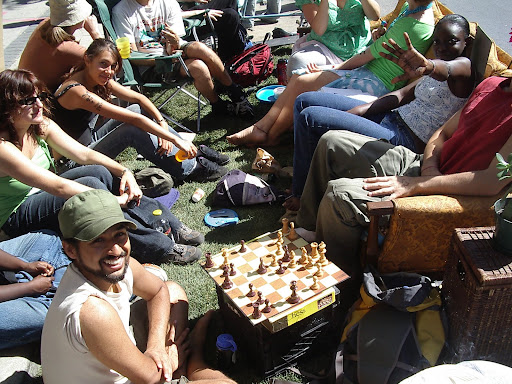
It was transformed into a people friendly space with sod laid out on roadside parking spaces, and a 'found' comfy couch installed (one person didn't get up the entire time!)
People sat playing chess, blowing gorgeous HUGE soap bubbles, or sipping lemonade. My kids (sadly the only ones in attendance) happily got tattooed with face paint. There was a free bike repair clinic too and best of all, music! Wonderful violinist and guitar duo, they performed for over 2 hours!
This is an idea that should be extended into car free weekend. Check out the organizer's web site at tlchamilton.blogspot.com
by BEE
Subscribe to:
Posts (Atom)
